Sunday, 19 June 2016

This weeks walks

One of our favourite walks is from the village, up to Tarn Hows by one of the various routes, around the tarn and back by another route. It is a varied walk with lots of fabulous views, no great height and not too strenuous, it usually takes about two and a half hours.
Thwaite Farm, just as you are leaving the village on the Hawkshead road.
Enjoying the view on arrival at the tarn.
At this time of year the Yellow Flag Iris populates the damp margins on the edge of the tarn.
Another plant that loves the soggy margins is the Dactilorhyza Maculata or Heath spotted orchid. They are just starting to make an appearance and over the coming weeks will make quite a show as more and more of them come into flower.
It seems to be a good year for cotton grass. Another plant that likes wet ground or even bog, the cotton grass is carpeting the wet areas of the fells at the moment. A couple of days later and we were heading over to Langdale to climb Harrison Stickle. It's a long time since we have done it because it gets very busy at weekends, but now that we have the time to go mid-week we decided it was time to revisit. an early start saw us leaving the car and heading up Stickle Ghyll at 8.30. The path has been paved since we were last here and I understand that it has to be done when erosion gets out of control, but there is something about it that makes the walking much less enjoyable. I haven't quite worked it out yet, but something about these paved paths makes them much more uncomfortable than they were in their natural state.
Irene, tackling the 'new' path that leads up to Stickle Tarn.
Looking down into the valley at Side House Farm, Langdale.
Looking across to Elterwater quarry.
The view back down into the Langdale Valley towards Lingmoor, with Windermere in the distance.
A view of the Coniston Fells from Langdale. Looking over Blake Rigg (in sunshine) to (L to R) Wetherlam, The Old Man summit and Great How.
Stickle Tarn and Pavey Ark.as we approached the tarn, the skies darkened, the temperature dropped and it started to drizzle. Decision time. Do we press on up Harrison Stickle, or do we turn back? Well we knew that we could complete the walk, but we have always believed in the importance of enjoying our walking and not in the importance of completing a walk regardless of conditions. So we made the decision to turn back and continue the enjoyment of the walk. Many would have continued and good luck to them, but we preferred the comfort of staying warm and dry, after all, we can come and do the full walk anytime we like.
I've Beverly seen myself as someone who lives in their own little bubble, but this morning, I looked into a mountain stream and there I was! .................................................................................................................................................................. The next day and we stayed in our 'home' valley of Coniston and walked up the Coppermines Valley and on up to Levers Water. Then through Boulder Valley, past Pudding Stone and onto the Old Man road, returning to the village via Mill Dam.
Levers Water is the water supply for Coniston and the surrounding area and was about six feet below full, but with the rain we have had since, I doubt there is any need to panic. At 123 feet deep, there is a good volume of water to go at. What was more concerning was finding used, disposable nappies and bits of toilet tissue below the high water mark!
Looking back from Levers Water, down towards a very calm lake and Brantwood.

Monday, 6 June 2016

D Day. June 6th 1944

On our way back through France we called into Normandy, the site of the D Day invasion on the 6th June 1944. The French treat the day with the importance it deserves, there is so much to see here and so much to learn from the past.
We arrived at Arromanches, the site of Mulberry Harbour, a massive temporary construction made in the months following D Day, to allow troops and supplies into France. We then headed over to Pegasus Bridge and Ranville, the Airborne Bridgehad.
And this is why we keep returning to Normandy. My wife Irene's Dad, Denis Moreland, arrived in Normandy by glider in the first minutes of the sixth of June 1944. He was one of the "Pathfinders" who's role was to capture and secure the bridge over the Orne canal prior to the D Day Invasion. The bridge was captured successfully and from then on known as Pegasus Bridge, after the insignia of the 6th Aiborne Division who carried out that brave and heroic mission that commenced the liberation of France. This picture is in the Airborne Museum at Pegasus Bridge and Denis, Gunner Moreland, is in the middle of the back row, aged 19.

D Day. June 6th 1944

On our way back through France we called into Normandy, the site of the D Day invasion on the 6th June 1944. The French treat the day with the importance it deserves, there is so much to see here and so much to learn from the past.
We arrived at Arromanches, the site of Mulberry Harbour, a massive temporary construction made in the months following D Day, to allow troops and supplies into France. We then headed over to Pegasus Bridge and Ranville, the Airborne Bridgehad.
And this is why we keep returning to Normandy. My wife Irene's Dad, Denis Moreland, arrived in Normandy by glider in the first minutes of the sixth of June 1944. He was one of the "Pathfinders" who's role was to capture and secure the bridge over the Orne canal prior to the D Day Invasion. The bridge was captured successfully and from then on known as Pegasus Bridge, after the insignia of the 6th Aiborne Division who carried out that brave and heroic mission that commenced the liberation of France. This picture is in the Airborne Museum at Pegasus Bridge and Denis, Gunner Moreland, is in the middle of the back row, aged 19.

Friday, 3 June 2016

Coniston Old Man

We have been back home in Coniston just over a week now and thought it was time we tackled Coniston Old Man (again). This was the first mountain I ever climbed and it is the one I have climbed most regularly. At a height of 2,635 feet there are many higher in The Lake District, but few harder. It's a tough walk, no getting away from it, but it's a great walk in the right conditions and today the conditions were perfect.
We left the village early, around 7 a.m. To make the most of the cool morning and to beat the hoardes that would no doubt be heading along the same route later in the morning. We took the route through the Coppermines Valley, onto the Old Man road, through the quarry and up to Low Water. The views widened as we gained height and there were already one or two hardy walkers out on the trail.
The path from Low Water to the summit has had some much needed attention in the past year, but it is still a hard pull up onto the ridge and then the final push up to the top.
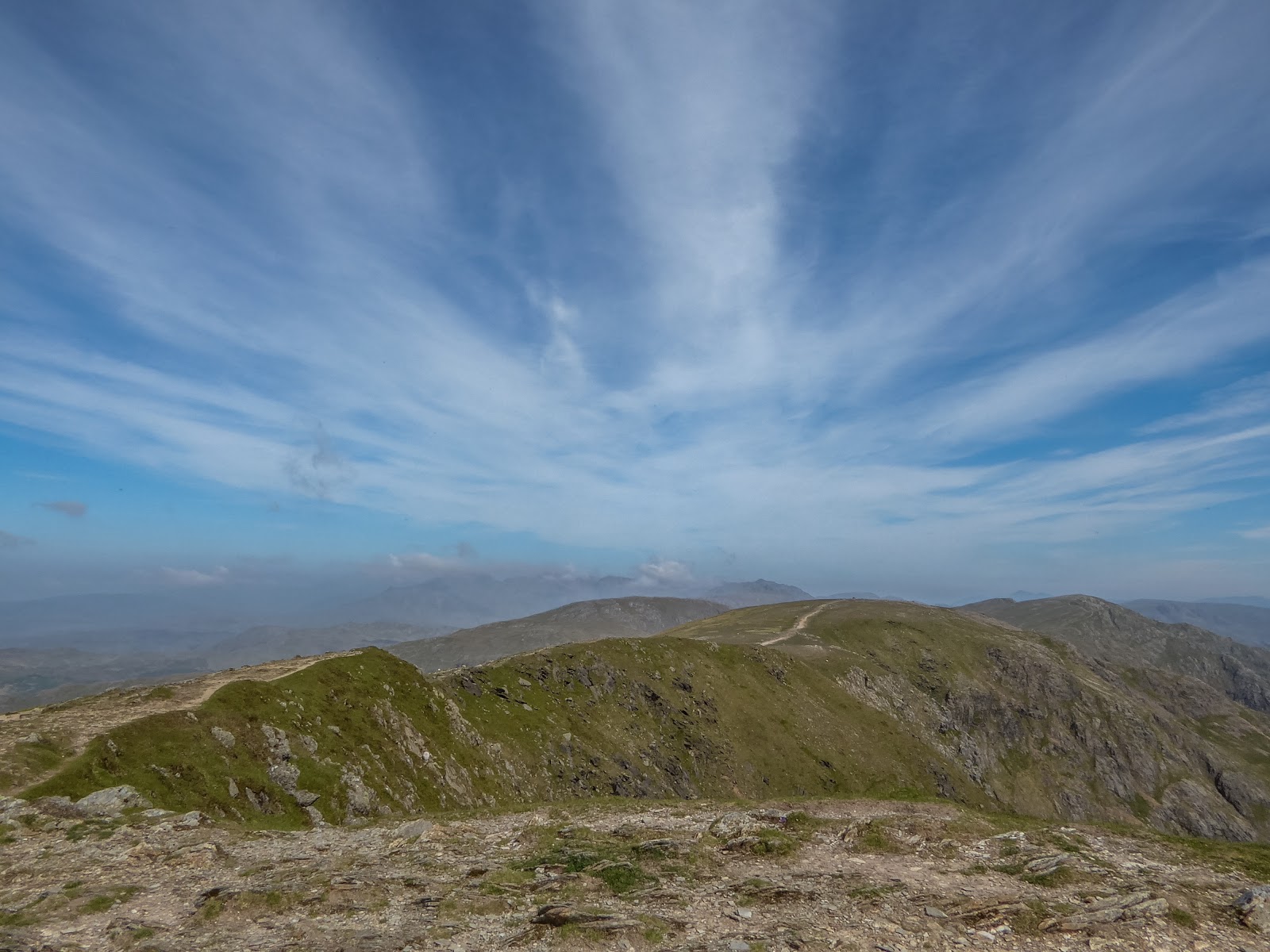
I must get a selfie stick......nah, maybe not. The views from the top were fabulous, but not as clear as I have seen, but it's always different. There were some interesting cloud formations adding to the general photogenic nature of the scene. There are some big skies from the mountain tops!
Our route down took us for a short distance along the ridge towards Brim Fell before veering left and down to Goats Hawse, with fabulous close up views of Dow Crags.
The path lead us down to the shores of Goats Water, an area of huge slabs of rock. The tarn itself was calm, that in itself is a remarkable feature. Usually rough and rippled by the prevailing south westerly winds, today it was calm and in the shelter of the Old Man, due to the fact that the weather is unusually, coming from the northeast.
The summer is taking hold in the mountains, just five weeks after the last snow and many of the summer mountain flowers are in bloom. The fell side is taking on a different look as the bracken comes through and the hills go bright green.
Butterwort, a small carnivorous plant that flowers in the wet areas in early June.
Mossy Saxifrage, which prefers the dry and loose slopes of the old quarry tips. The summer birds are back too. Sky larks and all the numerous different flycatchers as well as the very numerous Wheatear, seen in the photo below. We also caught sight of the less common Ring Ouzel, but they are much more elusive and difficult to capture in photograph.

Thursday, 2 June 2016

Back Home

We are back home in the Lake District again, after seven weeks plus, wandering around France. It's unbelievably good to have good internet access again after weeks of snatching a connection here and there, or sitting watching the timer go round and round. It did prevent regular updates on here, which is what I had intended to do, but over the coming weeks I will post some of the pictures. There are so many to sort through, from landscapes and flowers of the Languedoc, to the Chateaux of The Loire, to the battlefields of Normandy. Meanwhile, here's one that I have taken since coming home. It is the descent into Tilberthwaite, near Coniston.

Sunday, 17 April 2016

Due to a little local difficulty with the internet it has not been possible to post as regularly as i had wished. Hopefully this will be resolved soon, sorry if you are as disappointed as i am about this.
This is the view from where we are staying, 2,500 feet up in the mountains. So it's hardly surprising that the internet connection isn't brilliant.

Monday, 4 April 2016

We came across this ram on Sunday morning, he looks like he's grown a beard.
I was a bit surprised to see this pheasant up on the fells.